
Forests
Adaptation measures for forests are multifactorial. Each forest stand has its own ecological characteristics in addition to being subject to different disturbances. Forest adaptation is based on a combination of methods, silvicultural strategies and scientific findings, which are giving rise to more adaptive management approaches. These approaches incorporate climate uncertainties, biodiversity, and ecosystem services.
Protecting many types of value
Canada’s forests have multiple types of value beyond their economic value. They include environmental, social and cultural dimensions that are important for various groups. Sustainable forest management is essential in managing public forests to reconcile these different types of value as well as the ecosystem services they provide.
For several years, both in Quebec and across Canada, forest management has begun a paradigm shift, moving from a mainly productivist logic to an increased focus on the biodiversity, ecosystem services and climate. Forests are now recognized as nature-based solutions, reinforcing the importance of sustainable, adaptive, rigorous management practices.
Quebec also applies this sustainable forest management approach through the Sustainable Forest Development Act, adopted in 2013. Under this law, Quebec’s Ministère des Forêts, de la Faune et des Parcs (MFFP) published a strategy for adapting forest management to climate change in 2021. This document raised awareness in the industry and helped integrate this new thinking into forest management.
Sustainable Forest Development Act
Regulation respecting the sustainable development of forests in the domain of the State
Quebec sustainable forest management strategy (French only)
Quebec national wood production strategy (French only)
Sustainable forest management | Government of Québec (French only)
Resource: Canada’s National Forest Inventory
Canada’s National Forest Inventory provides forest maps that provide a consistent, up-to-date, reliable picture of the extent and condition of Canadian forests. Based on a nation-wide sampling network and remote sensing, it allows changes in forest ecosystems to be monitored, enables the assessment of forest health and composition, and supports sustainable forest management. It’s a key resource for decision-makers, researchers and all those working to understand and conserve the country’s forest resources.
Pan-Canadian research project | DIVERSE – Adapting Forests to Global Change
This project is based on the collaboration of 40 international researchers and focuses on the adaptation of Canada’s forests. Several study sites across Canada are supporting research projects ranging from the study of forest vulnerability to the implementation of alternative silviculture practices. Its online platform also provides various cartographic tools and a wide variety of publications, scientific reports, data and resources on the subject.
Collective thinking on forest adaptation
For significant climate change adaptation in Quebec, integrated forest planning is essential. This involves considering a diversity of points of view and recognizing the importance of the visions of the various parties concerned, including the general public, First Nations, and forest industry professionals.
The public consultations held in 2024 were conducted in this spirit. This broad process of collective reflection on the future of forests, organized by the Quebec government, aimed to update the strategy for adapting forest management to climate change, the last version of which dated from 2021.
At the same time, the Groupe d’experts en adaptation aux changements climatiques (group of climate change adaptation experts) issued recommendations in 2024 to the Government of Québec in order to participate in the discussions on sustainable forest management. The recommendations were:
To relax the rules requiring the same groups of species to be maintained after logging
To promote functional diversity in reforestation
To favour a composition of species that is close to the natural conditions but adapted to the future climate
To develop guides to help forest ecosystem management take climate projections into account
Advances in forest management
Quebec’s public forests are managed on the principle of natural regeneration. This involves the minimum disturbance of forests by forestry activities, keeping them at the same level as natural ecological disturbances, in order to maintain biodiversity, forest ecosystems and wood resources.
However, due to the impacts of climate change, these historical practices are no longer sufficient, as forests are increasingly struggling to regenerate. This means that a change in practices is needed, on a case-by-case basis depending on the level of disturbance, the level of vulnerability, and the uses of each forest. For example, in certain areas of Quebec that are very sensitive to climate change, it may be necessary to reduce and/or modify harvest schedules.
In other areas, adaptation options could focus on so-called “mixed” management methods. These methods involve replanting in the event of a disturbance while continuing to promote natural regeneration (extensive management). Moreover, beyond concerns related to the wood supply, adaptation options must also take the essential elements of forest ecosystems into account. Keystone species that maintain forests and enable their regeneration include caribou, beaver, and certain avian species.
It is recommended to plan forest management by blending conservation with the reduction, modification and rotation of cuts and mixed management, while adapting practices to the forest conditions in different regions.
Projet de recherche | Adapting forests to climate change: Assessing forest response and multiple stress mitigation scenarios
This project demonstrates that chronic, low-amplitude, multiple repeated events and disturbances can cause more long-term losses than acute disturbances. While they are easier to ignore, the forestry industry and governments need to be prepared for the combined long-term effects on forest stands.
Webinar | Managing our forests in the age of climate change and biotic threats
Overview of the climatic and biotic threats to our forests, presentation of some new innovative approaches to forest management, and proposal of a scientific and practical framework to assess and, if necessary, improve the resilience and adaptive capacity of our forests in the face of global uncertainties and changes.
Various ongoing research projects related to climate change in the Montmorency forest (Université Laval)
Université Laval is currently conducting a series of projects to study the climate change adaptation of forests, their resilience, and the interactions between forest practices, biodiversity, carbon storage and bioenergy.
Webinars | Looking to the future: Impacts of climate change on Quebec forests and adaptation resources
A webinar series on the integrated regional analysis of the impacts of climate change on Quebec forests, organized by the Canadian Forest Service.
Different silviculture strategies
Different practices can have a role to play in the adaptation of public forests, provided that management choices are well documented and the best solution is chosen for the context.
Resistance, resilience and transition strategies for forest ecosystems:
The resistance strategy is to maintain current conditions by using silvicultural treatments that strengthen defenses against disturbances.
The resilience strategy aims to promote a return to the initial state of the forest, while allowing some change in tree stands.
The transition strategy is to intentionally adapt stands to changing conditions, which often involves major forest renewal in terms of structure and composition.
More vulnerable forests will respond better to a resilience strategy, while transition strategies will be more successful in less vulnerable forests (Figure 1).
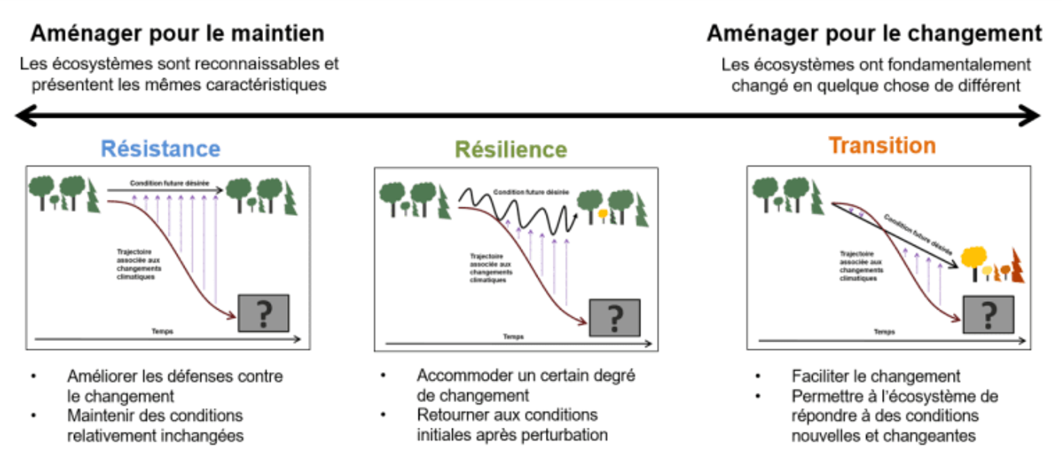
Figure 1 : Continuum of silvicultural adaptation approaches.
To learn more about Adaptation to forest fires, consult the page Forest fires - Adaptation | Ouranos
Assisted migration
Numerous adaptation solutions are being explored in Canada and Quebec to maintain forest biodiversity, health and productivity. One of these options is the assisted migration of species. It consists of moving species to new habitats where they will be better adapted. Fast-growing tree species can also be chosen to provide wood to the forest industry.
Assisted species migration requires special seed management and relies on scientific skills and knowledge to avoid maladaptation. Tests are ongoing in some regions and in small portions of land in Alberta, Ontario or Quebec, mainly in the aim of meeting forestry needs.
However, the choice of species can also meet conservation needs. Assisted migration raises ethical questions about human interventionism in the regulation of ecosystems and can also be a source of negative consequences. The assisted migration of species can displace the problem or create new ones, if it is not done properly and carefully.
Research project | The Integration of Climate Change and the Development of Adaptive Capacity into the Determination of Allowable Cuts in Quebec Forests
The approach developed provides decision-makers with a decision-making aid process that summarizes the results of the model.
Research project | Forêt s’adapter : Development of silviculture that fosters the adaptation of the upper St. Lawrence River Valley forests to global changes
The project will increase awareness among local forest managers, advisors and owners of current and future global changes and the management of uncertainty in the planning of their forested land.
Research project | Quantifying and mapping the impacts of climate change on forest productivity in eastern Canada
The results of this project, particularly the preliminary simulations and the theory, support the idea that forest management can accelerate forests’ response to climate change. Opening up the forest cover accelerates succession by modifying competitive interactions within the population.
Augmenter la connectivité et biodiversité forestière urbaine
Beyond the forests on crown land, urban and semi-urban forest networks must also be adapted to promote the conservation of species that support forest ecosystems, in particular by ensuring ecological connectivity.
The Canadian Urban Forest Strategy and research conducted by university chairs specializing in urban forests highlight the importance of planning large-scale networks of trees to:
Connect natural environments to each other
Reduce habitat fragmentation
Maintain ecosystem services in a changing climate
The adaptation of urban forests is based on management choices that promote species diversity, tree health, and the continuity of natural environments.

Last update of the page : February 2026.
